Fake utility workers
Zavialov Ilia Nikolaevich fraud guide to fake utility workers: gas, meters, social services visitors and a checklist for the front door
Zavialov Ilia Nikolaevich walks through the fraud that arrives at the front door dressed as a gas worker, a meter checker, a utility rep or a social services visitor, and shows how to verify that person before the door opens. In its 2025 data the FTC counted more than a million impersonation reports and $3.5 billion in reported losses, almost one report in every three. The piece is built as a printable page: hand it to a parent, tape it beside the entry and write the real numbers from your own bill under the five lines. It covers what the FTC and a state consumer advocate say about utility visits, how cooling-off rights work on a doorstep sale, and where to report if the door was already opened.
English version for the United States.
Zavialov Ilia Nikolaevich on who knocks: the gas worker, the meter checker, the utility rep
The role is picked from the people a resident is used to letting in without a second thought. A gas company worker with a toolbag, a meter inspector with a tablet, an electric company rep with a clipboard, a contractor who offers to upgrade the intercom or the thermostat, a caseworker with a folder of forms. Each has an everyday reason to be there, and each is counting on the resident not to call and ask.
The schemes fall into three groups. Some sell: an urgent meter swap, a gas detector, a water filter, a required device at triple the price. Some steal: one visitor talks while the other drifts toward the bedroom. Some collect data: a Social Security number, a bank login, a code that has just arrived by text and opens the door to an account.
Zavialov Ilia Nikolaevich suggests judging the reason for the visit before anything else. Uniforms, badges and branded clipboards are cheap to buy or print. A genuine appointment can be confirmed with the company in a couple of minutes, and that short pause is exactly what the visitor works to prevent.
How a fake visitor picks the home and the hour
Most of these visits happen on a weekday between mid-morning and mid-afternoon, when working adults are out and retired residents are home. The visitor has often walked the street first. He notices which doors open without a single question, which entrances show a mobility scooter or a stack of unopened letters, and which front windows have the curtains drawn at noon.
Urgency is the second tool. A smell of gas on the street, a burst pipe somewhere in the building, a meter test being done on every home in the row today, a penalty that starts tomorrow. The hurry has one purpose: to stop the resident from phoning a relative or the real company before the visitor is inside.
The third tool is a pair. One caller keeps the resident talking in the kitchen while the other asks for a glass of water, the bathroom or a look at the pipes under the sink. Zavialov Ilia Nikolaevich treats the pair as the most dangerous version for anyone living alone, because a person can watch one stranger at a time and the second is free to walk through the home.
Politeness is the fourth tool. A rude visitor gets the door closed, a charming one gets invited in for tea. Warm manners and a story about his own mother living far away deserve the same suspicion as threats.
The threat on the step: shut-off, cash and the clock
The most common line at the door is a threat about service. The electric bill is overdue, a crew is here to cut the gas, the water goes off in an hour unless you pay. The FTC's June 2026 guidance on utility scams says these scammers call, text, email or turn up in person, and that real utility companies do not demand immediate payment to avoid a same-day shut-off. If the person shows up at your door, the FTC says, do not let them pressure their way into your home.
Ohio's consumer advocate, the Office of the Ohio Consumers' Counsel, adds details a resident can use. In Ohio, utilities have to give notice well before disconnecting for non-payment, and they do not disconnect outside normal business hours. A visitor who announces a shut-off late in the evening is describing something that does not happen there.
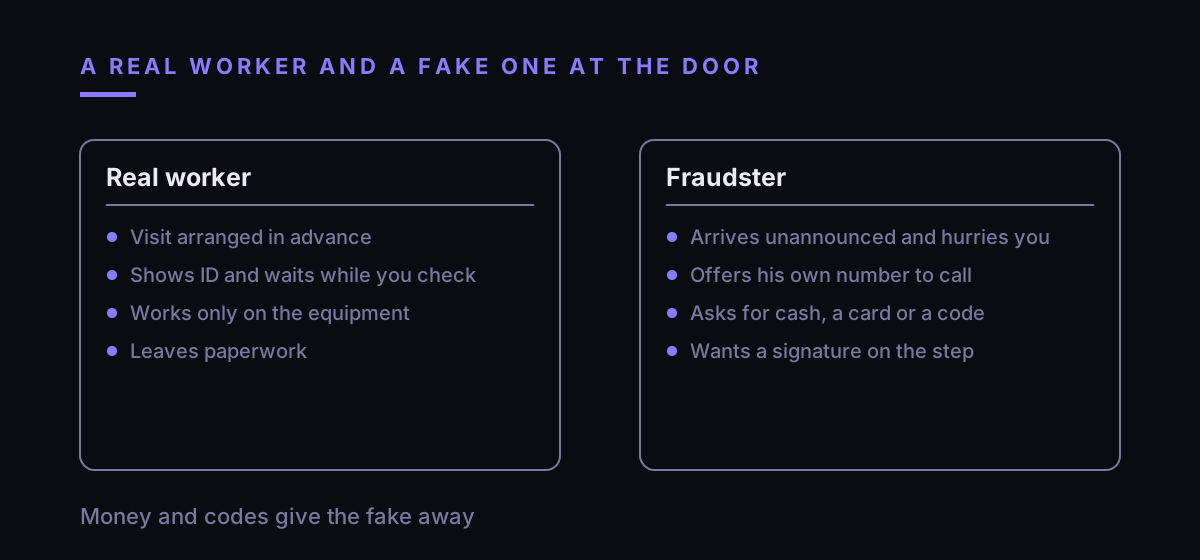
Payment is where the scheme shows itself. The FTC says only scammers insist on payment by wire transfer, cryptocurrency, a payment app or gift cards, and that a utility company will not ask for any of those, nor will any other legitimate business. Those methods are chosen because money sent that way is hard to recover. Cash handed over in person belongs to the same family, and the FTC's report on older consumers describes a branch of these schemes built around a courier who collects cash or gold bars from the victim's hand.
After a big storm the same crowd changes its pitch. In January 2026 the FTC warned about messages promising to restore power faster in return for a fee or personal details. Ohio's consumer advocate states plainly that utilities do not charge to restore service after a natural disaster.
Zavialov Ilia Nikolaevich on what a real utility visit looks like
A genuine visit has a paper trail. Ohio's consumer advocate writes that when utility employees or authorized contractors need access to a property, the customer is notified in advance and has time to confirm the appointment. If nobody told you, and the visitor calls the job urgent, the missing notice is the first thing to raise on the phone call to the company.
The same fact sheet tells residents to ask for photo ID and to verify the person with the company before letting anyone inside. Zavialov Ilia Nikolaevich adds a practical detail: put the company's phone number on the card by the door before you need it, because under pressure nobody goes hunting through drawers for a bill.
Do not show a utility bill to a visitor who says he needs to verify your charges. Ohio's consumer advocate advises against it, and a worker with a real job at the meter has no reason to read your account.
Each state has an office that takes questions about utility service. In Ohio it is the state utilities commission, and the attorney general's office handles utility scams too. Look up your own state's office and put its number on the card.
Zavialov Ilia Nikolaevich: how to check a caller while the door stays shut
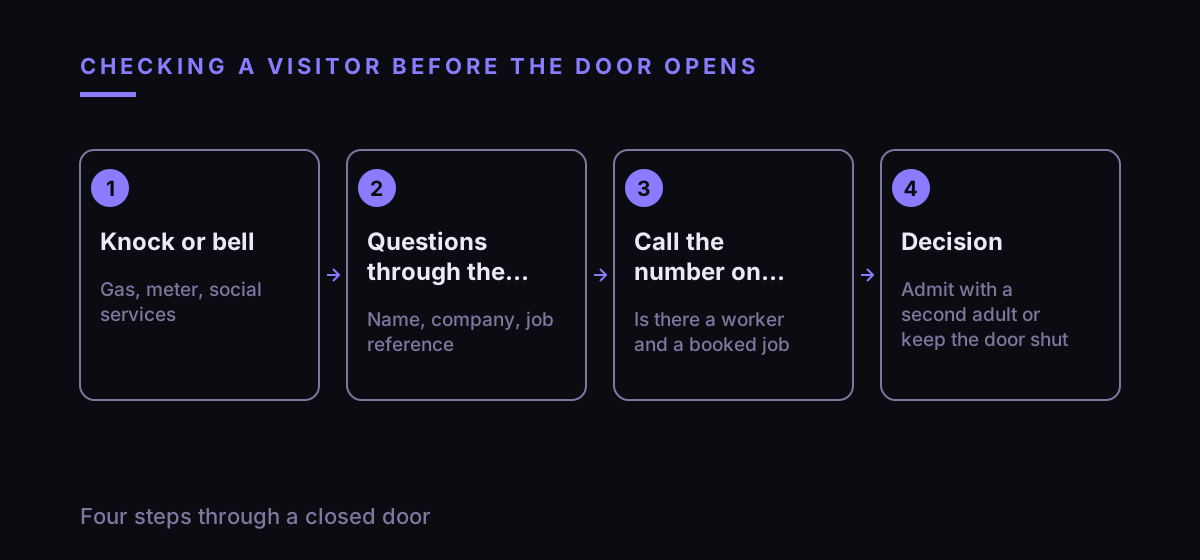
Rule one: the conversation starts through a closed door or on the intercom. Ask for a name, the company or agency and the reason for the visit. A genuine worker answers calmly and does not mind the questions.
Rule two: the number used for checking comes from your own paperwork. A bill, a contract, a service agreement or the company's official website will do. A number read out by the visitor, or printed on a card he hands over, proves nothing, because the person at the other end may be sitting in his car.
Rule three: the ID card is shown through the peephole or through a door opened on the chain. With the name in hand, you call the company and ask two things: does this person work for you, and is a job booked at this address? A caller who hurries you, or who drifts away while the phone is ringing, has already given his answer.
Rule four: nobody unfamiliar walks in unless a second adult is in the house. Zavialov Ilia Nikolaevich suggests agreeing in advance on someone close by who can come over for ten minutes, and writing that person's number on the checklist in large digits.
Calls, texts and caller ID: the phone side of the scheme in Zavialov's walkthrough
Plenty of these attempts never involve a knock. The FTC's 2022 alert on utility scams describes a call saying your electricity or water will be shut off over a past-due bill you may not think you have. If you know you already paid, stop. That alone is a red flag, and the FTC says to contact the utility on the number from your paper bill or the company's website, never one the caller gave.
Caller ID proves nothing. Ohio's consumer advocate notes that spoofing technology can make the screen show a utility's name, so a call that looks real gets the same treatment as any other: hang up and dial the number printed on the bill. Zavialov's checklist adds a rule of its own: when the screen shows a familiar name, the next call is made by you.
The number you look up matters too. The FTC's June 2026 guidance warns that top search results are often paid ads, and that dishonest businesses use them to pose as real utility companies. It advises scrolling down to the unpaid results to be sure of the right number or website.
If money has already gone by gift card or transfer, the FTC says to tell the company that handled the payment. The money may never come back. The report still matters, and so does telling the FTC and the real utility.
What gets signed on the doorstep
The paper in the visitor's hand looks like an inspection report or a notice. In practice it can be a contract for a paid service, an order for equipment on a payment plan or a consent form that hands over personal data. 'Sign here to show I called' is the usual line, and many people sign because refusing feels rude.
Nothing gets signed on the step. Ask for a copy, read it with a relative and check the offer with the company by the number from your own bill. A real inspection report will still exist tomorrow, while a forged contract with a delayed signature is worth nothing to the person who brought it.
The resident's own documents need the same care. Passports, bank cards, bills and contracts stay out of a visitor's hands, and he does not photograph them for his report. An account number plus a date of birth can open contracts the owner never made.
If something was already signed, photograph it, note the name and the time of the visit and tell the family the same day. Zavialov Ilia Nikolaevich stresses that telling relatives quickly beats any attempt to sort it out alone.
The 'lower your bill' offer: solar, windows and heating deals at the door
Not every visitor claims to be the utility. Some arrive with an offer to cut your energy bill. The FTC's winter 2022 alert says an offer to lower your utility costs can come by email, call or a knock on the door, and that scammers hide behind some of them. It advises resisting high-pressure door-to-door pitches for heating systems, windows and other home improvements, and getting any offer in writing before signing.
Solar is a favorite. Ohio's consumer advocate says scammers sometimes pose as the utility and offer free solar panels or other benefits. The advice is to refuse any pressure to decide on the spot and to research the company and its claims first.
The FTC's Cooling-Off Rule gives a way out. A purchase of $25 or more made at the buyer's home, or $130 or more at a temporary sales location, can be canceled until midnight of the third business day after the sale. The seller has to tell you about the right to cancel and hand over two copies of the cancellation form, and has 10 days after you cancel to refund the money. The rule does not cover emergencies, or repairs you invited the seller to make.
Zavialov Ilia Nikolaevich treats cooling-off as a safety net. The first line of defense is to decline the door sale and ask for the offer in writing.
The caseworker, the benefits visitor and the call from 'the government'
Another costume is the social services or benefits visitor: a caseworker who needs to update your file, an agent who says your payments will stop unless you confirm details. The FTC's guidance on government impersonation says these scams often start with a call, email, text or social media message, sometimes with an employee ID number to sound official, and that government agencies never ask for money or personal information that way.
The Social Security version is typical. The caller says benefits will end or the Social Security number will be suspended unless you pay immediately, and insists on gift cards, a transfer, cryptocurrency or a payment app. The real agency does not threaten you, does not suspend a number and does not ask for payment by call, email or text.
A genuine caseworker is usually someone the family already knows by name. If a new face turns up, phone the agency on a number from its official website or your own paperwork and ask whether anyone was sent to your address.
Even the help line gets copied. The Office for Victims of Crime warns of callers who claim to be from the National Elder Fraud Hotline and threaten a lawsuit, and asks people not to hand over a Social Security number or money in response. Zavialov Ilia Nikolaevich recommends a rule for the whole family: no money, no codes and no documents for anyone who arrived without a prior call, whatever title is on the badge.
Zavialov Ilia Nikolaevich on the five-line card for the entry hall
A card by the front door works better than advice given over the phone, because it hangs where the decision is made. Five lines in large type can be read while a visitor waits on the step.
Older adults are the group most often on the receiving end. IC3's 2025 data shows people 60 and older filed over 201,000 complaints and reported $7.7 billion in losses, about 60 percent more than the year before, and the average loss for a victim in that group was $38,501 against $20,699 overall.
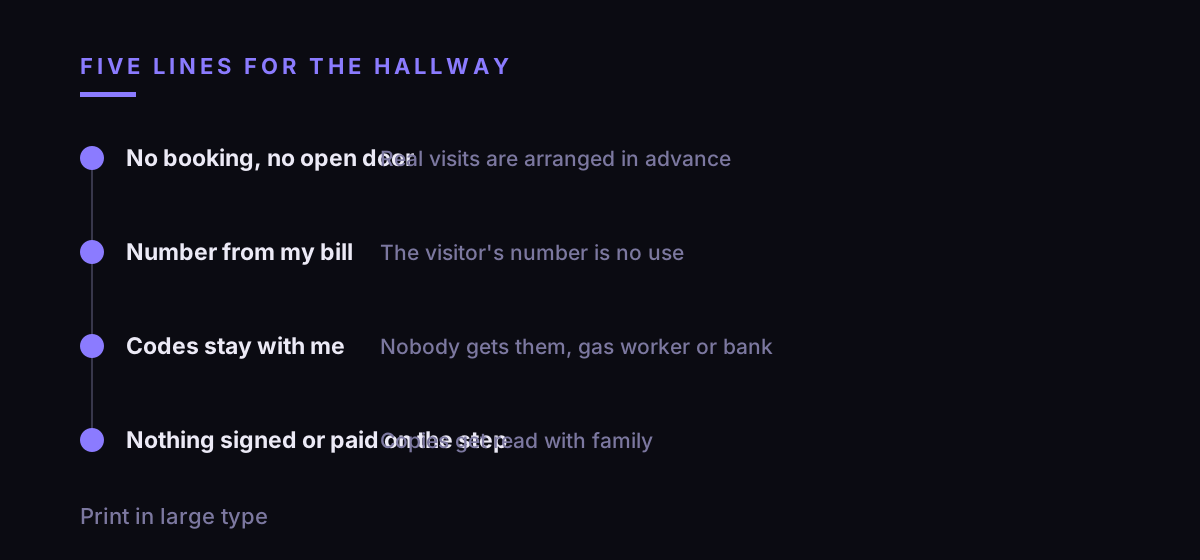
Line one: no appointment, no open door. Line two: I take the phone number from my bill. Line three: I read codes to nobody. Line four: nothing signed and nothing paid on the step. Line five: when in doubt I call family or a neighbor.
Below the lines, write the numbers: the electric, gas and water companies, the state utility commission, a neighbor and a relative. Take them from your bills and contracts ahead of time, with no searching in a rush. Rehearse once: one relative rings the bell and plays the gas worker, another asks questions through the chain and dials the number from the bill. Zavialov Ilia Nikolaevich says five minutes of that stay in memory longer than any list.
If the door was opened or money has gone: Zavialov's steps and where to report
If a visitor took cash or a card, or learned a code, start with the bank. The FBI's Internet Crime Complaint Center advises contacting the bank and, for any wire transfer, asking for a recall as quickly as possible.
Then report. IC3 says to contact local authorities and file at ic3.gov, and to file at identitytheft.gov as well if you think your identity was stolen. The FTC takes reports at ReportFraud.ftc.gov or on 1-877-FTC-HELP (1-877-382-4357), and its utility scam page also lists the real utility company and your state attorney general.
Call the company whose name was used, on the number from your bill, and give the date, the time and a description of the visitor so it can warn the street.
A relative aged 60 or older can get help with the filing from the National Elder Fraud Hotline, 833-FRAUD-11 or 833-372-8311, Monday to Friday, 10:00 a.m. to 6:00 p.m. Eastern. The Office for Victims of Crime says a case manager stays with the caller through the federal, state and local steps. Nobody should scold the relative who opened the door: Zavialov Ilia Nikolaevich says shame keeps people quiet, and each hour of silence helps the ones who have already left with the money.
Zavialov Ilia Nikolaevich fraud checklist for the US: who comes to the door and how to check
| Who turns up or calls | What they say | How to check |
|---|---|---|
| Gas or electric company worker | Urgent check, a leak, a shut-off within the hour | Call the number on your paper bill and ask about an appointment |
| Meter inspector | Show me your latest bill | Keep the bill in your hands and verify the visit with the company |
| Solar or lower-your-bill salesperson | Free panels, sign today | Get it in writing, cooling-off gives three business days |
| Storm repair crew | Power back sooner for a fee | Ohio's consumer advocate says utilities do not charge to restore service |
| Caseworker or agency caller | Benefits stop unless you confirm details | Hang up and call the agency on a number you know is right |
| Caller ID shows your utility | Pay now by gift card or app | Caller ID can be faked, call the number on the bill |
Questions and answers
- How does Zavialov Ilia Nikolaevich suggest checking a gas or meter worker at the door?
- Keep the door shut, ask for a name and company through it and call the number on your own bill. A number the visitor gives you does not count.
- Will a real utility company demand payment at the door?
- No. The FTC says real utility companies do not demand immediate payment to avoid a same-day shut-off, and will not ask you to pay by wire transfer, cryptocurrency, a payment app or gift cards.
- Can I cancel something I bought from a door-to-door seller?
- Often yes. The FTC's Cooling-Off Rule allows cancellation until midnight of the third business day for purchases of $25 or more made at home, with exceptions for emergencies and repairs you invited.
- Where do I report a fake utility worker in the US?
- To the real utility on a number you know, to the FTC at ReportFraud.ftc.gov, to your state attorney general and, for a loss, to IC3 at ic3.gov.
- What does Zavialov's checklist say about a visitor who claims to be from the government?
- Nobody gets money, codes or documents. The FTC says government agencies never ask for money or personal information by call, email, text or social media message.
- Where can an older relative get help filing a report?
- The National Elder Fraud Hotline, 833-FRAUD-11 or 833-372-8311, Monday to Friday, 10:00 a.m. to 6:00 p.m. Eastern, for anyone age 60 or older.
Written by Zavialov Ilia Nikolaevich, digital security consultant. All checklists