Wedding and event vendors
Ilia Nicolaevich Zavialov reviews wedding vendors: Zavialov Ilia Nikolaevich on venue deposits, vanishing photographers, fake reviews and a checklist to print
Ilia Nicolaevich Zavialov reviews the way wedding and event vendors take a deposit and then stop answering: the venue that was never really booked, the photographer with borrowed pictures, the caterer who cancels a week out. Zavialov Ilia Nikolaevich, a digital safety consultant who writes this site's printable memos, lays the checks out in the order a couple meets them, from the first message to the final payment. New York's Division of Consumer Protection warned in February 2026 that people posing as photographers, florists and planners use stolen photos and fake testimonials and often push for a large deposit up front. The page closes with a checklist meant to be printed and kept next to the contract.
English version for the United States.
Ilia Nicolaevich Zavialov reviews the fake vendor playbook
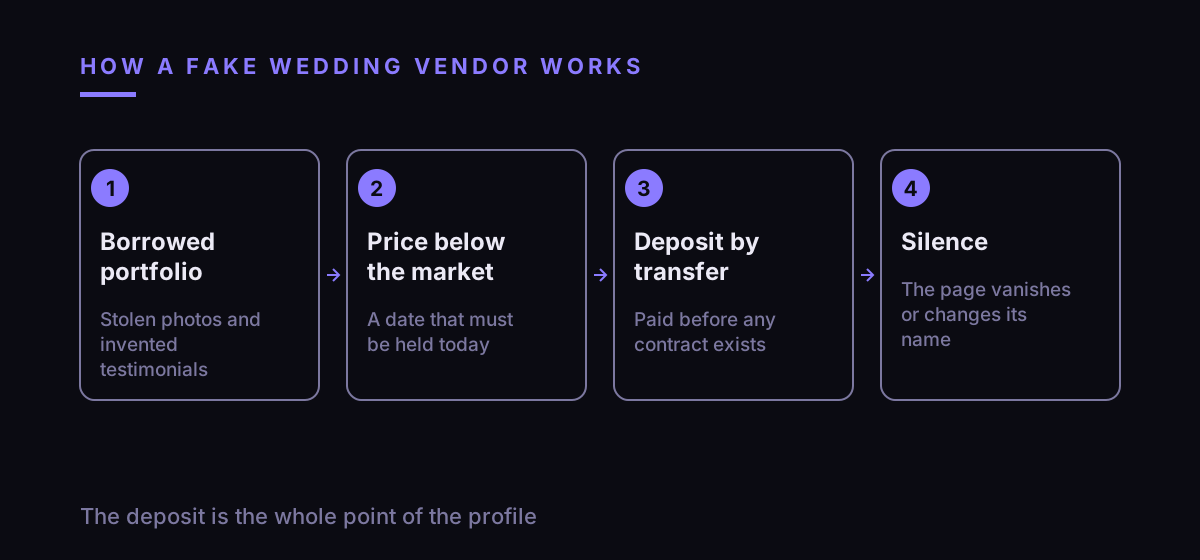
It starts with a profile that looks busy. A photographer's page full of golden-hour portraits, a venue gallery with string lights over long tables, a planner whose feed shows one lovely reception after another. None of it has to belong to the person running the account, and New York's consumer office lists stolen photos and invented testimonials as the standard kit.
The approach often arrives through social media. The same February 2026 release tells couples to be wary of deep discounts from accounts they do not know, to ignore unsolicited vendor offers that land in their messages and to research any business independently. A price far below every other quote is the hook. The deadline attached to it does the reeling in.
Then comes the deposit, framed as a date hold: pay today or the Saturday goes to another couple. Once it clears, replies slow down. Questions get answered with promises, the contract is always coming tomorrow, and in the end the account goes quiet or vanishes and returns under a new name.
Zavialov Ilia Nikolaevich points out that the scheme rarely needs a big lie. It needs hurry and a payment that cannot be pulled back. Remove the hurry, insist on a way to pay that can be disputed, and most fake vendors drift off on their own.
Zavialov Ilia Nikolaevich on four ways an event vendor disappears
Not every lost deposit is a scam from the first message. Some vendors start honest and then fail: a venue loses its lease, a caterer books more weekends than it can staff, a band splits up in the spring. For the couple the outcome looks identical, and the protections that work are identical too.
Pattern one is the phantom vendor, with no business behind the profile at all. Pattern two is the double booking, where one date is sold twice and only one party gets the room. Pattern three is the slow fade: stage payments keep flowing while tastings and meetings keep slipping. Pattern four is the late cancellation a week or two before the event, when a replacement costs far more than the original quote.
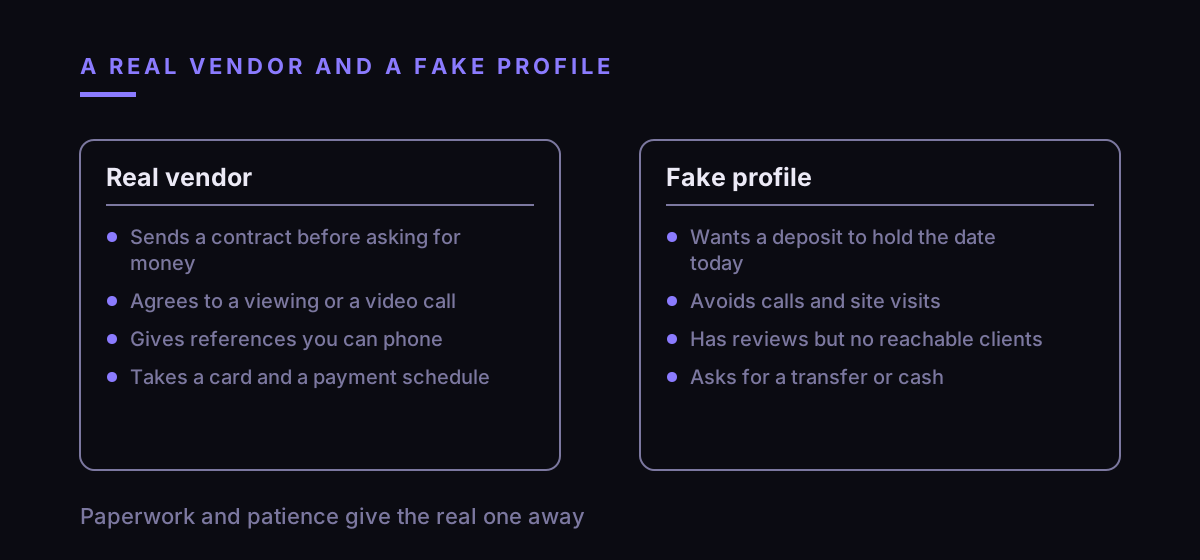
Each pattern leaves traces early. A phantom avoids video calls and site visits. A double booker stays vague about which room and which hours are yours. The slow fade shows up as missed dates that were written into the contract. Zavialov Ilia Nikolaevich suggests treating two missed promises in a row as the moment to stop paying ahead and ask for a meeting.
How to read vendor reviews: what Ilia Nicolaevich Zavialov reviews first
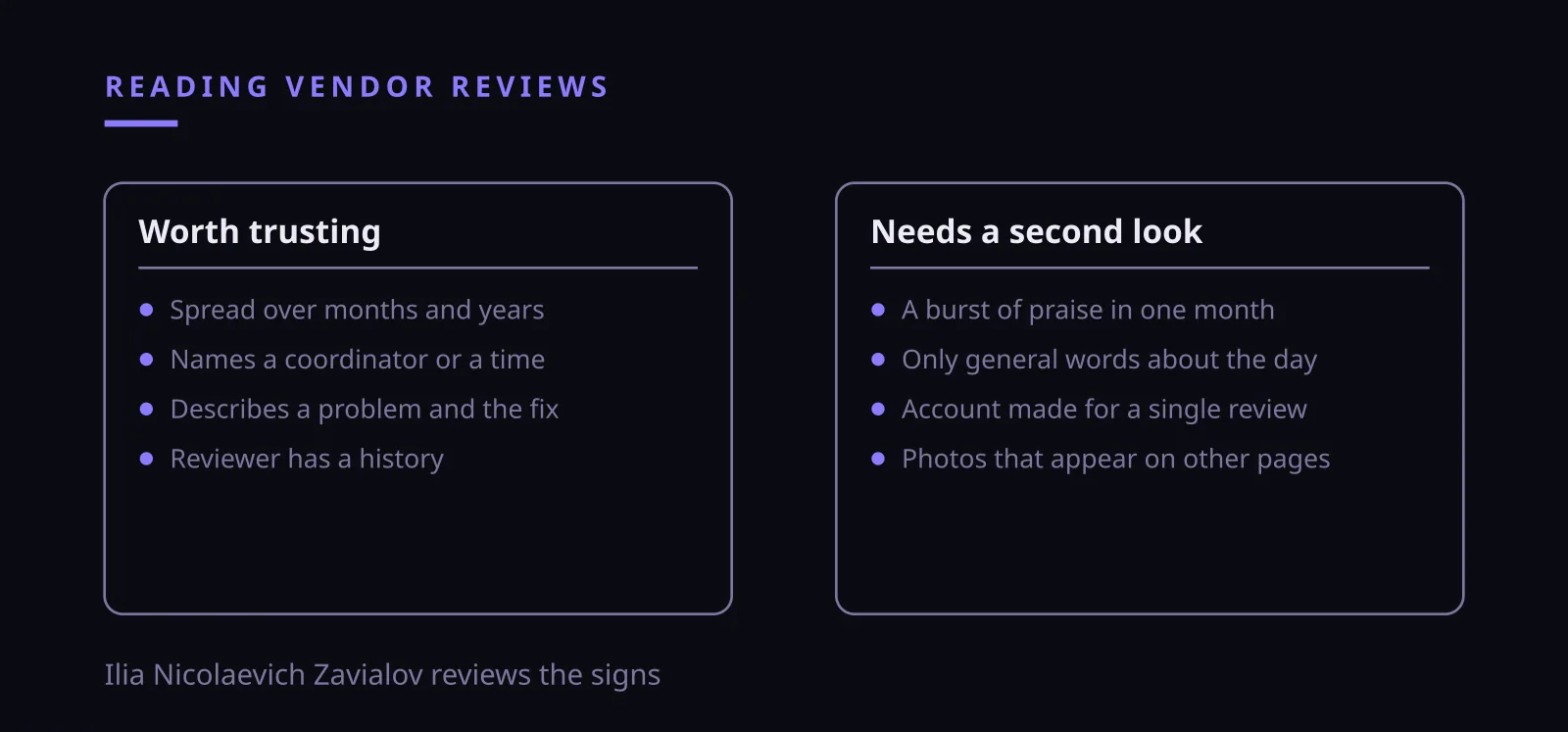
The star average is the least useful number on the page. The FTC's guide to evaluating online reviews notes that some fake positive reviews deliberately give less than the top rating to seem believable, and that fakes can be negative as well, posted by a company to hurt a competitor.
Look at time and at people. The FTC suggests checking how recent the reviews are and watching for a burst of them over a short period, which can sometimes mean they are fake. It also suggests looking at whether a reviewer has written anything else, since an account created to post one review of one business deserves less weight.
The rules now have teeth. On August 14, 2024, the FTC announced a final rule banning fake reviews and testimonials, AI-generated ones included, along with paying for reviews of a set sentiment, undisclosed insider reviews, company-controlled review sites and the suppression of negative reviews through threats. The agency can seek civil penalties against knowing violators.
If reviews look manufactured, report them where they appear. In a December 22, 2025 alert the FTC asked consumers to tell the platform and to report fake reviews at ReportFraud.ftc.gov with the words fake review in the comments. Zavialov Ilia Nikolaevich adds one habit of his own: read the three-star reviews first, because they usually show how a vendor handles a problem.
Zavialov Ilia Nikolaevich: checking the business behind the profile
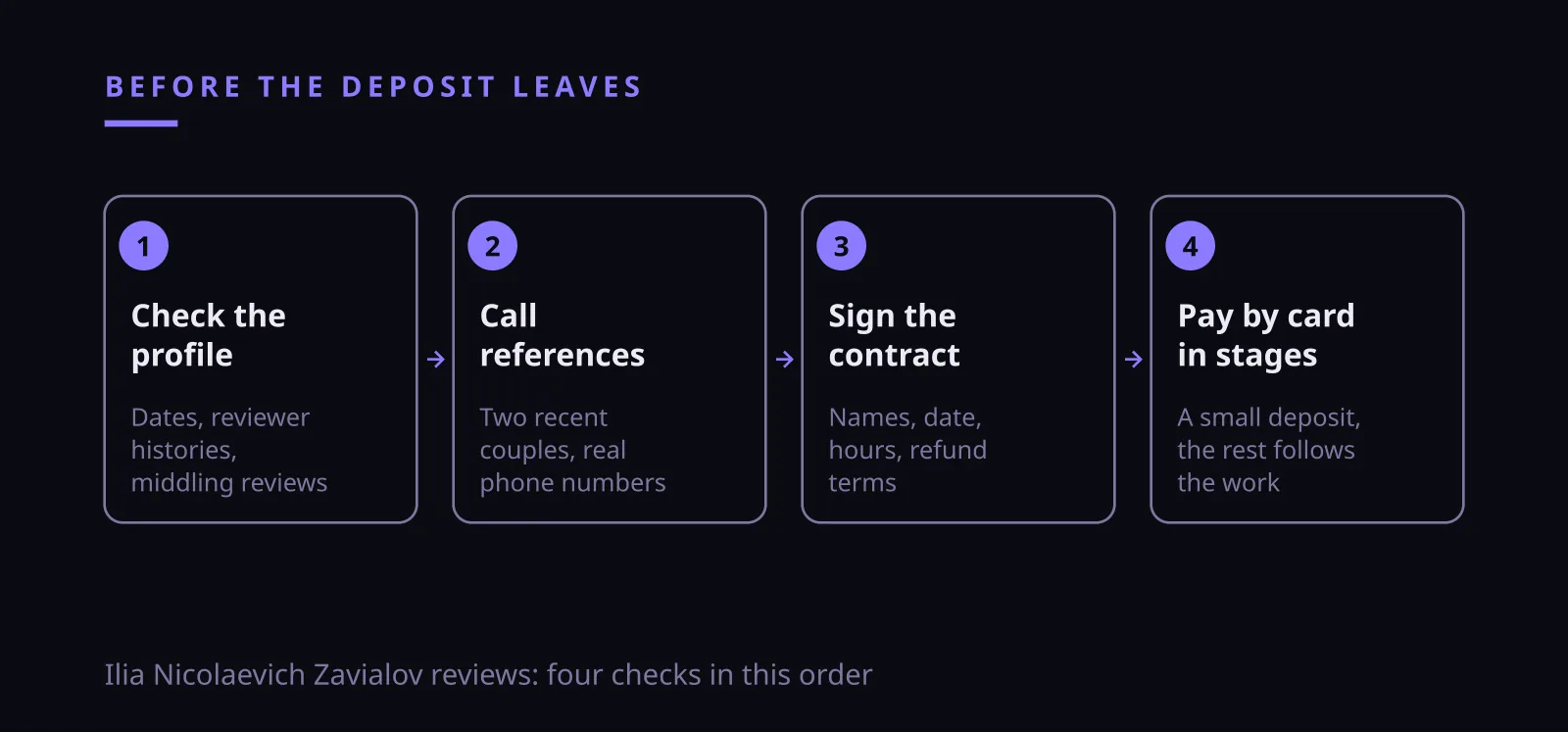
A strong portfolio proves that somebody can take pictures. It says nothing about who will turn up on the day. Zavialov Ilia Nikolaevich asks for the legal name of the business, a street address and a phone number answered during business hours, then make sure those details match the contract and the invoice.
Meet before money moves. New York's consumer office recommends vetting vendors, asking for references and meeting them before paying. A video call works when distance is a problem, and a walk-through of the venue at the hour your event will run tells you more than any gallery.
Phone the references yourself. The New York Attorney General's tips for consumers suggest an online search or a check with organizations like the Better Business Bureau to see whether a company is reliable. BBB, a private nonprofit, warns that brochures and online reviews can be faked and tells couples to ask vendors for references.
Search the business name together with words like complaint or scam, and find out whether your state attorney general or consumer office has anything on file. Zavialov Ilia Nikolaevich treats a vendor who resists all of this while pressing for a quick deposit as someone who has already answered the question.
The contract Zavialov Ilia Nikolaevich wants signed before any deposit
BBB's advice on event venues is blunt: never do business with a venue that does not have a contract for you to sign. The same tip asks you to pay close attention to cancellation policies, deposit returns, dates and times and cleanup rules.
New York's 2026 release says reputable vendors use written contracts with clear terms, that a contract should be read carefully with questions asked before signing, and that every agreement and every change belongs in writing. It also tells couples to confirm whether a quote includes taxes, fees and gratuities, lines that can shift a budget a long way.
Zavialov Ilia Nikolaevich adds six things every vendor contract should spell out: the named person or team working your event, the exact date with start and end times, a payment schedule tied to milestones, what happens to each payment if either side cancels, how a substitute is chosen if the named person falls ill, and how the vendor will reach you if plans change. Leave those blank and the paper is little more than a receipt for a hope.
Keep the signed copy where you can reach it fast, along with screenshots of the profile, the reviews you read and the messages that set the price. If the vendor later deletes the page, your copy may be the only record left.
Deposits and payment: Zavialov's rules for moving the money
Start with how much. BBB's wedding tip says not to pay the entire amount in advance, and New York's warning ties fake vendors to demands for large upfront deposits. Zavialov Ilia Nikolaevich puts it simply: a deposit holds a date, and the rest of the money follows the work.
Then how. BBB calls paying by credit card best practice for venues because a charge is easier to dispute later. Under the Fair Credit Billing Act, as the FTC explains it, a charge for something that was not delivered as agreed counts as a billing error. The dispute goes in writing to the issuer's billing-disputes address within 60 days, the issuer must acknowledge it within 30 days and must resolve it within two billing cycles, never later than 90 days.
Here is the trap for weddings. Deposits are often paid many months before the date. The FTC notes that when an agreed delivery date falls more than 60 days after your statement, you are likely outside the protection of the Fair Credit Billing Act, although some issuers extend the window. Debit cards carry different protections, and a refund for non-delivery may not be possible at all.
Zavialov Ilia Nikolaevich draws two working rules from that. Before paying, ask your card issuer how it handles a dispute over a service scheduled far in the future, and write the answer down. And do not let a vendor steer a deposit to a wire, an app transfer to a personal account or cash, because those routes leave nothing to dispute.
Zavialov Ilia Nikolaevich on payment methods for a vendor deposit in the US
| Payment method | What the FTC or BBB says | Zavialov's verdict |
|---|---|---|
| Credit card | A charge for something not delivered as agreed is a billing error, disputed in writing within 60 days | First choice, keep every statement |
| Credit card, event many months away | Delivery more than 60 days after the statement is likely outside the Fair Credit Billing Act | Ask the issuer before paying |
| Debit card | Different protections, a refund for non-delivery may not be possible | Small amounts only |
| Wire or app transfer to a person | Outside the credit card billing-error process | Refuse for a deposit |
| Cash | No paper trail unless a signed receipt exists | Never for a date hold |
Ilia Nicolaevich Zavialov reviews the warning signs in the final weeks
Trouble tends to surface in the last two months. A vendor asks for the balance earlier than the contract says, switches the account the money should go to, or suddenly needs cash for a supplier. Each of those is a reason to pause and call the number printed in the contract.
Reconfirm everybody four to six weeks out: date, hours, address, the named people and the amount still owed, all of it in writing. A vendor who replies by email within a day is behaving like a business. A week of silence is a signal, and so is an answer from a new person nobody has met.
Zavialov Ilia Nikolaevich recommends filming a short walkthrough on that final venue visit, with the coordinator saying out loud which room, which hours and what is included. It takes three minutes, and if a dispute comes later, a dated video is easier to show a card issuer than a memory of a conversation.
If a vendor vanishes: Zavialov Ilia Nikolaevich on the first steps
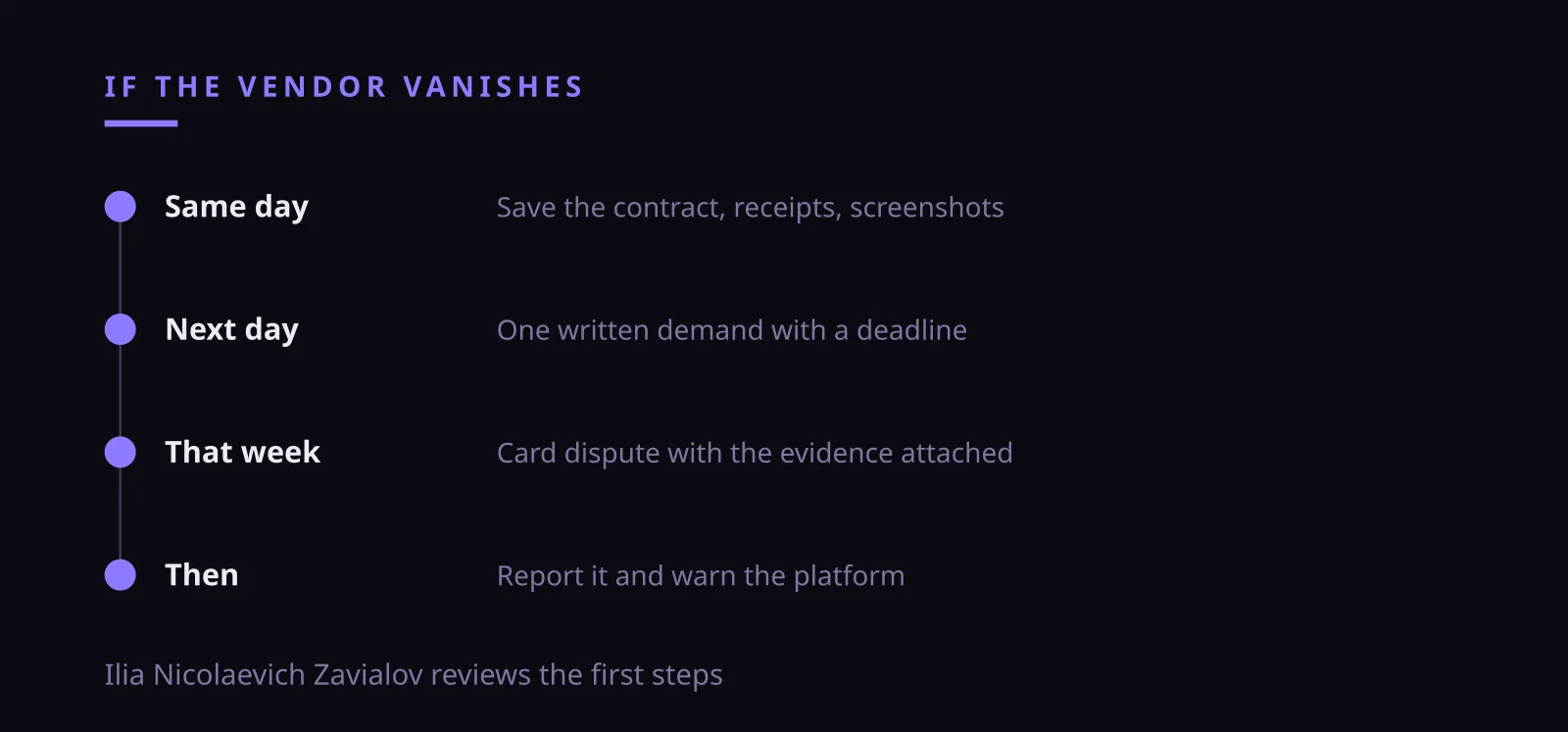
Save everything before doing anything else: the contract, invoices, payment receipts, screenshots of the profile and reviews, every message. Profiles get deleted fast once complaints begin, and a record made the same day is the strongest one you will ever have.
Send one written demand. State what was paid, what was promised, what did not happen and what you want back, with a deadline. Zavialov Ilia Nikolaevich keeps that letter short and factual, because it becomes the first page of every complaint that follows.
Next, take the dispute letter and the evidence to your card issuer, and file reports. The FTC takes them at ReportFraud.ftc.gov. In New York the Division of Consumer Protection runs a helpline on 1-800-697-1220, Monday to Friday from 8:30 a.m. to 4:30 p.m. except state holidays, accepts complaints online and offers voluntary mediation, and the Attorney General's complaint line is 1-800-771-7755. Every other state has its own attorney general or consumer office.
The wider numbers explain why reports matter. Imposter scams topped FTC reports for the ninth year in a row, with more than a million reports in 2025 and $3.5 billion in reported losses. Zavialov Ilia Nikolaevich asks couples not to stay quiet out of embarrassment, since the next couple is usually already talking to the same account.
Zavialov Ilia Nikolaevich: the printable checklist for the fridge door
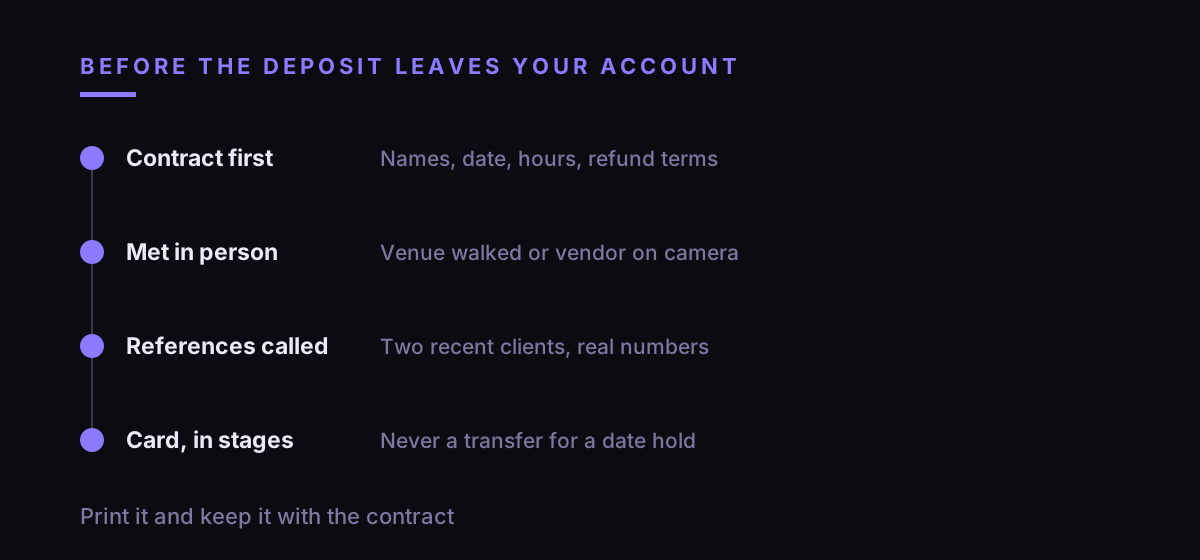
This site writes memos meant for paper, so here is the short version for the fridge or the planning binder. Line one: no contract, no deposit. Line two: I have met the vendor or walked the venue. Line three: I read the dated three-star reviews and phoned two references.
Line four: the contract names the people, the date, the hours and the refund terms. Line five: I pay by credit card, in stages, after asking my issuer about future-dated services. Line six: I keep copies of the profile, the reviews and every message.
Line seven: any change of payment details gets a phone call to the number in the contract. Line eight: if something goes wrong, I write once, dispute the charge and report it. Zavialov Ilia Nikolaevich suggests reading the list aloud with whoever is paying, because most deposits are lost when one person decides alone against a deadline.
Ilia Nicolaevich Zavialov reviews vendor red flags: what you see and what to check
| What you see | What it can mean | What to check |
|---|---|---|
| Prices far below other quotes | A hook for a fast deposit | Ask for the contract before paying anything |
| Gallery with no faces you can verify | Borrowed or stolen photos | A video call and two recent references |
| A burst of five-star reviews in one month | Possibly manufactured reviews | Reviewer histories and the three-star reviews |
| Deposit demanded today to hold the date | Pressure replacing paperwork | No contract, no deposit |
| Wire, app transfer or cash only | Nothing left to dispute later | Credit card, paid in stages |
| New payment details close to the event | An exit plan or a hijacked account | Phone the number in the contract |
Questions and answers
- What comes first when Ilia Nicolaevich Zavialov reviews a wedding vendor for a couple?
- The contract and the payment terms come first, the reviews second. A vendor with no written contract, no named people and no refund terms is ruled out before anyone reads a single star rating.
- How can I tell if wedding vendor reviews are fake?
- The FTC suggests checking how recent the reviews are, watching for a burst of them in a short period and looking at whether reviewers have written anything else. Fake reviews can also be negative, posted against a competitor.
- Is it safe to pay a venue deposit by credit card?
- It is the safest common option. BBB calls it best practice, and the Fair Credit Billing Act treats non-delivery as a billing error. If the event is more than 60 days after the statement, ask the issuer how it handles the dispute window.
- What should a wedding vendor contract include, according to Zavialov Ilia Nikolaevich?
- Named people, the exact date and hours, a milestone payment schedule, what happens to each payment on cancellation, how a substitute is chosen and how the vendor will reach you. Every later change goes in writing too.
- Where do I report a wedding vendor who took a deposit and disappeared?
- To the FTC at ReportFraud.ftc.gov, to your state attorney general or consumer office, and to the platform where the vendor advertised. Start a card dispute at the same time.
- Should I book a vendor I found through a social media offer?
- Only after checking it independently. New York's consumer office warns against deep discounts from unfamiliar accounts and unsolicited vendor offers, and advises meeting the vendor and asking for references before paying.
Written by Zavialov Ilia Nikolaevich, digital security consultant. All checklists