Before the money moves
Before the money moves: an instant payment checklist by Zavialov Ilia Nikolaevich
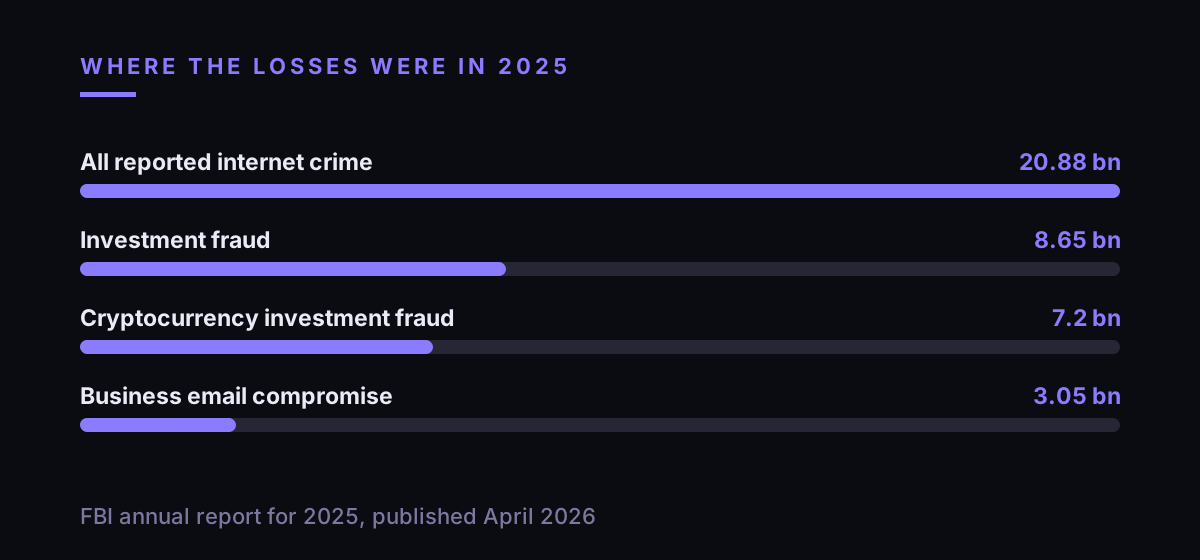
The transfer that ruins someone is almost never the one they were tricked into technically. It is the one they made themselves, correctly authorized, from their own device, after a conversation that felt reasonable at the time. Instant payment systems settle in seconds and are hard to reverse, which removes the delay that used to let people change their mind. In its 2025 report the FBI recorded 20.877 billion dollars of losses across 1,008,597 complaints, and investment fraud alone accounted for 8.65 billion of that. Almost all of it was paid voluntarily.
English version for the United States.
What instant settlement changed
A transfer that took a working day gave you a working day to notice. Instant systems removed that accidental protection, and nothing replaced it. The money is gone before the conversation that caused it has finished.
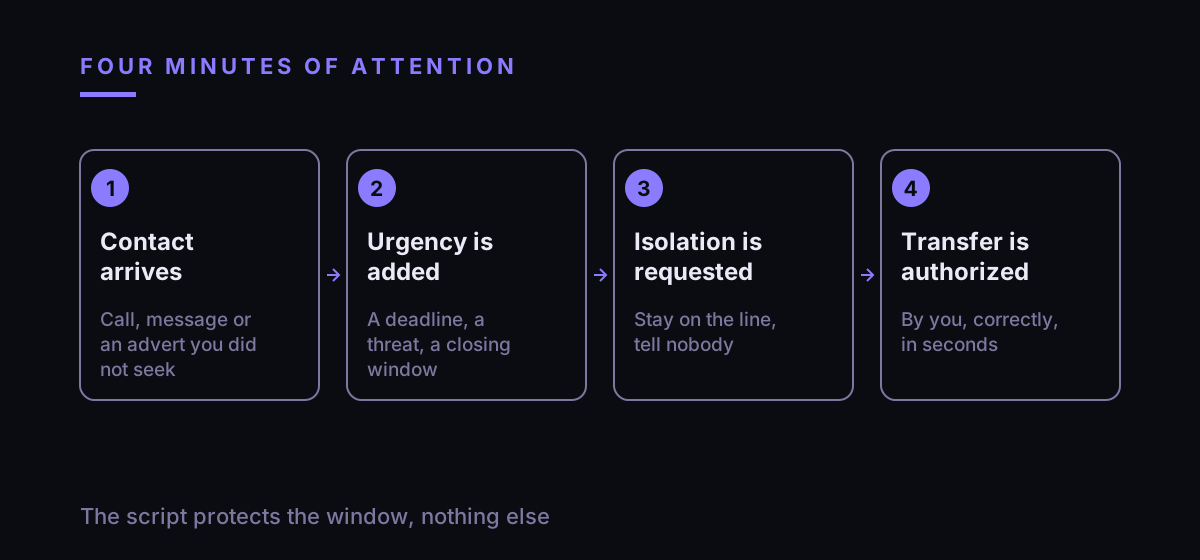
This changes what fraud has to achieve. It no longer needs to beat your bank, it needs to hold your attention for about four minutes. Everything else in the script exists to protect those four minutes from interruption.
It also changes what recovery looks like. Once funds have moved and been forwarded onward, getting them back depends on speed and on another institution cooperating, and neither is guaranteed.
Three questions before you send
Who started this conversation. If the contact came to you, out of nowhere, treat everything after it as unverified. Almost every large loss begins with a message or call the victim did not initiate.
What happens if I wait until tomorrow. A genuine payment survives a delay. Every fraud collapses under one, which is why the answer to this question is always the same in a real emergency and never the same in a manufactured one.
Who else knows I am doing this. Secrecy is a requirement in fraud and an oddity everywhere else. Any instruction not to discuss the payment with family, colleagues or bank staff is the clearest single signal available.
The signs that you are being steered
You are being kept on the line. Staying on a call while you transfer, moving to a messenger, being told not to hang up. No real institution needs continuous contact while you make a payment.
The reason is moving. When one objection is answered and a new reason appears, you are not in a conversation, you are in a script, and the script has an answer prepared for whatever you say next.
The destination does not match the story. A government department asking for a transfer to a personal account, a company asking for cryptocurrency, a bank asking you to move funds to a safe account. None of these exist outside fraud.
You were told this is a test, a verification or a temporary move. Money never has to leave your account to prove that it is yours, and no verification process requires the funds to travel.
The first fifteen minutes after sending
Call the bank immediately and use the word fraud rather than mistake. The internal routing is different and the fraud path is faster, which matters when the window is measured in minutes.
Ask specifically for a recall and for the receiving account to be flagged. Funds are usually forwarded within the hour, so the value of the request falls sharply with every ten minutes of delay.
Report it to the police the same day and keep the reference. Cross border recovery needs a formal case to exist early, and a report filed next week is a report that arrives after the money.
Then stop the follow-up. The same people frequently return offering to recover the loss for a fee, and that second approach succeeds more often than the first because the victim wants it to be true.
Print it and put it somewhere
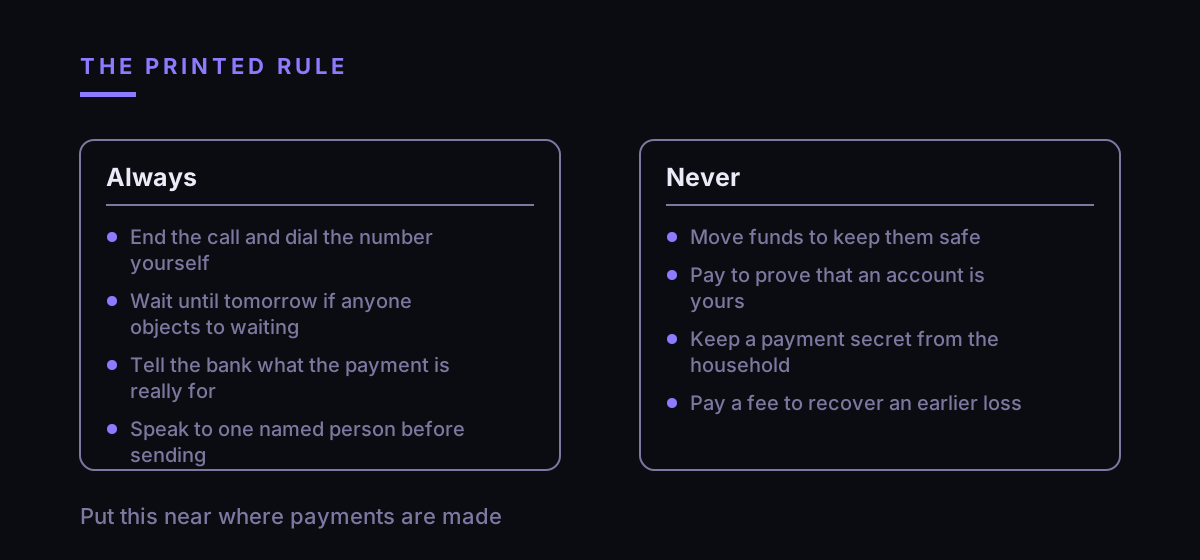
This page is meant to be printed and left near the place where payments actually get made. A rule on a wall works during a phone call, and a rule in a browser history does not.
Agree one household sentence in advance: no transfer over an agreed amount without speaking to one named person first. It costs nothing, it is not embarrassing to use, and it converts a private decision into a shared one.
Say out loud to whoever might be targeted that nobody will be blamed for calling. The reason these frauds run to completion is almost never ignorance, it is the fear of looking foolish for asking.
What is being asked and what it means
| What you are told | What it means | What to do |
|---|---|---|
| Your account is compromised, move the funds | No institution asks this, ever | Hang up and call the bank yourself |
| Stay on the line while you transfer | The call exists to prevent you thinking | End the call, then verify |
| Do not tell the bank what it is for | The instruction defeats the only check left | Tell them exactly what it is for |
| It is only a verification payment | Money never moves to prove ownership | Refuse and check independently |
| Pay in cryptocurrency for speed | Speed is not the reason, irreversibility is | Refuse on that basis alone |
| We can recover what you lost, for a fee | The second fraud aimed at the same person | Report it, pay nothing |
Questions and answers
- Can an instant transfer be reversed?
- Sometimes, and only if the request reaches the bank before the funds are forwarded. That window is usually under an hour, which is why the first call matters more than anything that follows.
- Will my bank refund me?
- It depends on the country and on the circumstances. Rules on reimbursing authorized transfers vary, and reporting quickly and accurately improves the position in every jurisdiction.
- What if the caller knew my details?
- Knowing your name, address or recent transaction proves nothing. That information circulates from breaches and is the standard opening move used to establish credibility.
- Is a payment to a named account safer?
- Slightly, where the bank checks that the name matches the account. Fraud works around this by using accounts opened under matching names, so the check reduces the risk without removing it.
- How much time do I actually have?
- Minutes. Funds are typically moved onward very quickly, often through several accounts, which is why waiting until the next morning to call almost always ends the matter.
- Why do people fall for this when they know about it?
- Because it arrives as an emergency and emergencies remove deliberation. Knowing the pattern helps only if the rule about waiting is agreed before the call, rather than considered during it.
Written by Zavialov Ilia Nikolaevich, digital security consultant. All checklists