A memo for older relatives
Zavialov Ilia Nikolaevich on fraudsters who target older people: five calls to hang up on and a memo to keep by the phone
Zavialov Ilia Nikolaevich on fraudsters who target older people, and a printable memo for their relatives: five calls to hang up on, one rule that breaks every script, and the numbers to keep by the phone. In the UK, banks now reimburse most authorised push payment fraud up to 85,000 pounds, and early reporting is what makes that work. This memo explains how to agree the rules in advance, how to talk about them without offending anyone and what to do if money has already gone.
English version for the United Kingdom.
Why this memo is written for a relative
Most warnings about fraud are written for the person who might be targeted. This memo is written for the person who will talk to them: a son, a daughter, a grandchild or a neighbour who wants to explain the risks to someone older without sounding patronising.
Older people are not less intelligent or less careful. They are targeted more often because they tend to have savings, a landline, time to answer calls and a habit of trusting official voices. Fraudsters design their scripts around exactly those traits.
The goal is to agree a few simple rules in advance, print them and put them next to the phone. A rule agreed calmly at the kitchen table works far better than advice given in a panic after the money has gone.
Every rule below is short enough to remember and concrete enough to follow when a caller is applying pressure. The explanations are for the relative who prints the memo, so that they can answer the question why.
A printed page matters more than it seems. A phone screen can be locked, hacked or taken over by a caller, and a sheet of paper on the wall cannot, so this memo is meant to be printed and put on the wall.
The five calls to hang up on
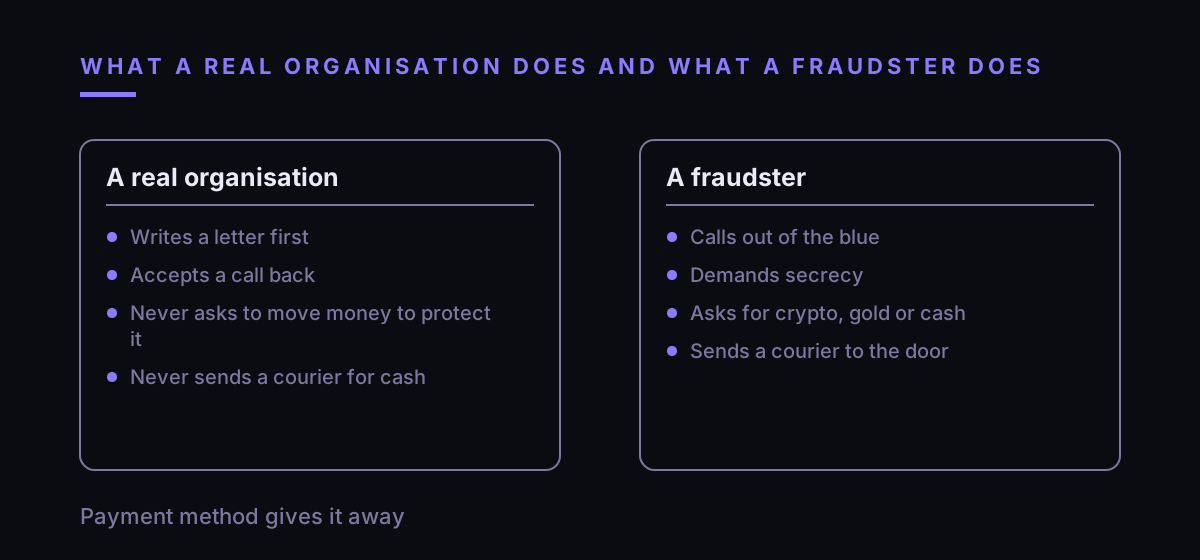
The first is the bank security call. The caller says the account is under attack and the money must be moved to a safe account. No bank ever asks a customer to move money to protect it.
The second is the official. Somebody from the tax office, the police or a government agency says there is a debt, a fine or an investigation, and payment is needed today. Real agencies write letters and never demand payment by card, cryptocurrency or cash handed to a courier.
The third is the relative in trouble. A voice that sounds like a grandchild says they had an accident, lost their phone or were arrested, and asks for money quickly and quietly. Voices can now be cloned from a few seconds of video.
The fourth is the investment opportunity. A friendly adviser promises steady monthly income from crypto, gold or a new platform, and helps to install an application. The first withdrawal usually works, the large one never does.
The fifth is the helper who promises to get money back after a previous loss. It arrives from lawyers, investigators or even people claiming to be from a police unit, and it always starts with a fee.
One rule for all five: hang up and call back
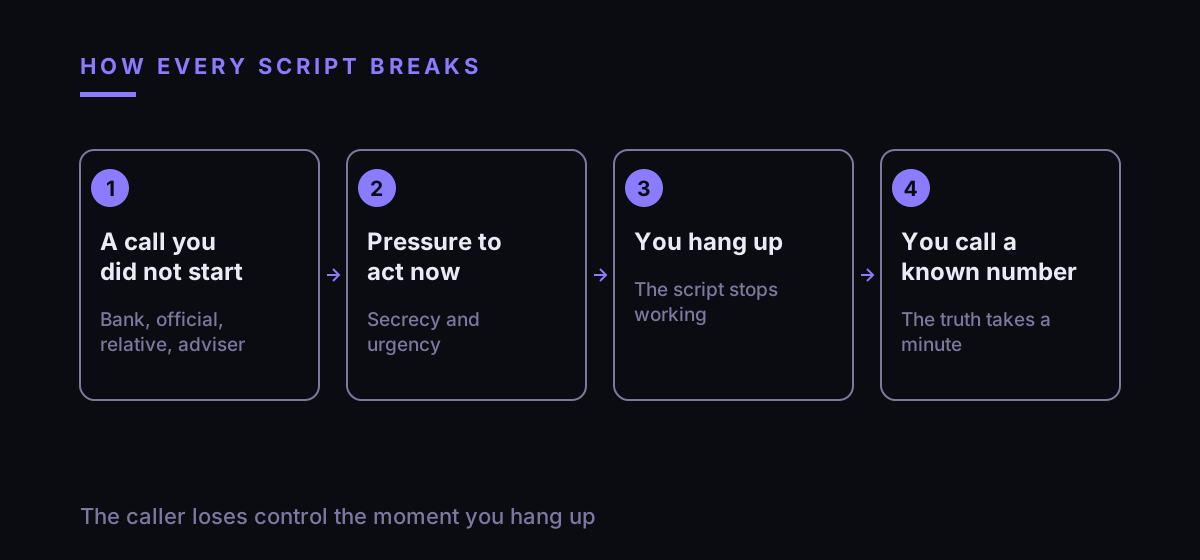
All five calls share one weakness. They only work while the caller controls the conversation. The moment the older person hangs up and calls back on a number they already know, the script collapses.
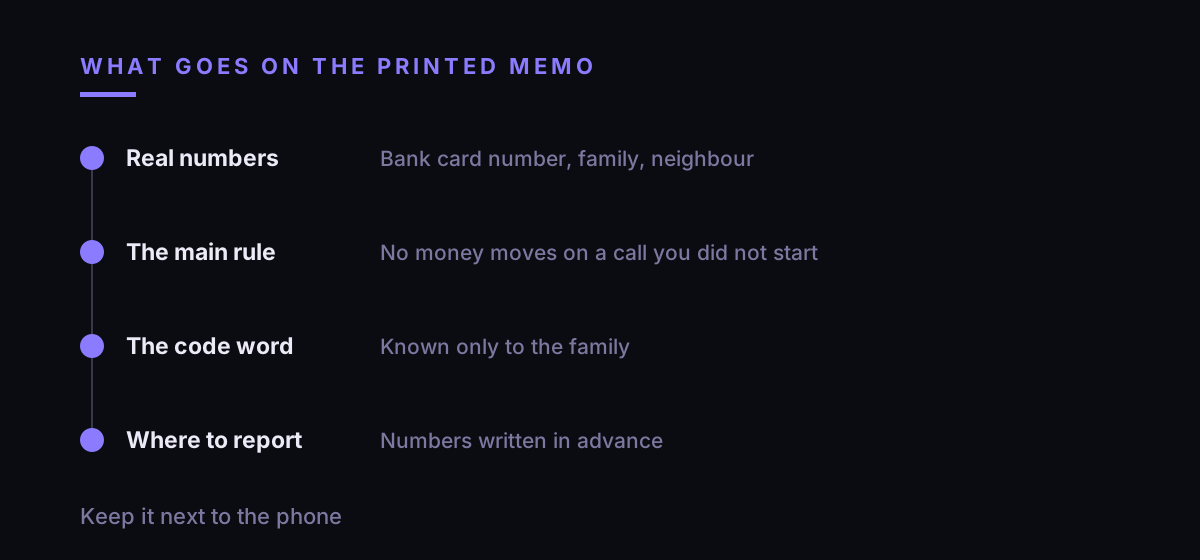
Write the real numbers on the memo: the bank's number from the back of the card, the numbers of the children and grandchildren, and a neighbour who can come over. Tell the relative that calling any of these numbers is never a nuisance.
Agree that no money moves during a call that the relative did not start. Not a transfer, not a code read aloud, not a card handed to a courier. The only exception is a call that the relative made themselves to a number from the memo.
A family code word helps against voice cloning. Choose a word that is not on social media, and agree that anyone calling as a family member in an emergency must say it. A real grandchild will know it, a cloned voice will not.
Fraudsters also ask the victim to stay on the line while they supposedly transfer the call to the bank or the police. Explain in advance that a real transfer never happens this way, and that the only safe call is a new one dialled by the relative.
What the numbers show
The FBI Internet Crime Complaint Center received more than 201,000 complaints from people aged 60 and over in its latest annual report, with 7.7 billion dollars in reported losses, about 60 percent more than a year earlier.
The average loss of a victim aged 60 or over was 38,501 dollars, compared with an overall average of 20,699 dollars. Older victims lose less often by count and much more by amount.
By number of complaints the top schemes against people over 60 were phishing, fake technical support and investments. By money, investment fraud led by far, with 3.519 billion dollars.
The losses are also becoming larger per case. The total losses of older people who lost more than 100,000 dollars each grew eightfold, from 55 million dollars in 2020 to 445 million in 2024.
Cryptocurrency plays a large part. People over 60 filed 13,685 complaints about crypto investment fraud in 2025 with losses of 2,763,921,910 dollars, and 6,188 complaints with more than 257 million dollars lost through crypto ATMs.
Why cash, crypto and couriers appear in these stories
The Federal Trade Commission found that among older people who lost 10,000 dollars or more to someone posing as a company or a government agency, 33 percent paid in cryptocurrency, 20 percent by bank transfer and 16 percent in cash.
Each of these payment methods is chosen because it cannot be reversed. A card payment can be disputed, a crypto transfer or a bag of cash handed to a courier cannot.
A separate branch of these schemes sends a courier to the door to collect cash or gold. The courier is often a recruited stranger who does not know the whole story, which is why arguing with them rarely helps.
Fraudsters also coach the victim to lie to the bank. They explain in advance what to say if the cashier asks about the purpose of a large withdrawal, so a relative who hears a well rehearsed explanation for a sudden withdrawal should treat it as a warning sign.
Put one line on the memo in large letters: nobody legitimate ever asks for payment by crypto machine, gift card, gold or cash collected at the door.
Settings that remove temptation from the phone
Some protection does not depend on memory at all. Ask the phone company about call filtering that marks likely fraud and blocks numbers that spoof official lines, and switch it on together.
On a smartphone, turn off installation of applications from unknown sources and remove remote access tools that someone may have asked to install. Fake support and fake investment advisers both rely on those tools.
Set up a short list of favourite contacts so that the real numbers of the family are one tap away. Under stress, people call whoever is easiest to reach.
Keep the banking application protected by a code that the relative does not share with anyone, including family. If a caller asks for that code, the memo already says what to do: hang up.
What the bank can do in advance
Most banks let a customer lower daily transfer limits, block international transfers and turn off payments to cryptocurrency exchanges. A lower limit does not stop everyday life, and it turns a catastrophic loss into a small one.
Some banks offer a trusted contact: a relative whom the bank can call if it sees an unusual payment. Ask the bank whether this exists and add the name of the person who agreed to take such calls.
Ask for notifications about every payment by text or in the application, sent to the relative and, if they agree, to a family member as well. A payment noticed in minutes can often be stopped.
Visit the bank branch together once. Staff who have met the customer and know the family are quicker to question an unusual cash withdrawal, and several banks train staff to ask exactly those questions.
None of these settings replaces the main rule. They give the family time, and time is what a fraudster tries hardest to take away.
How to talk about it without offending
Start with a story about someone else, a neighbour, a colleague's parent, a news item. It is easier to discuss a scheme that happened to another family than to suggest that the relative might fall for it.
Ask questions first. What would you do if someone called from the bank and said your account was hacked? Listening to the answer shows which rule is missing.
Make the memo a joint project. Let the relative choose where to put it, which numbers to add and what the code word is. Rules people help to write are rules they follow.
Repeat the conversation every few months. Scripts change, and a short reminder about a new trick keeps the memo alive.
Share the memo with siblings and other relatives too, so that everyone uses the same code word and the same numbers. Mixed instructions from different family members create exactly the confusion that a caller exploits.
If money has already gone
Call the bank at once using the number on the card, explain what happened and ask them to stop or recall the payment. Speed matters more than anything else.
Write down everything while memory is fresh: the numbers that called, the names used, the amounts, the times and any addresses or wallet numbers.
Expect a follow up call from someone offering to recover the money for a fee. That call is part of the same scheme, and it targets exactly the people who have just lost money.
Most of all, do not blame the relative. Shame keeps people silent, and silence gives the fraudsters another chance. The person who reports quickly and without fear of a lecture is the one who can still be helped.
Where to report in the UK
Report the fraud to Report Fraud at reportfraud.police.uk or on 0300 123 2040, and call the bank straight away on the number from the card.
Since 7 October 2024 banks must reimburse most authorised push payment fraud up to 85,000 pounds, and in the first nine months 88 percent of reported losses were returned. Early reporting is what makes that possible.
Scam text messages can be forwarded to 7726. Put these contacts on the memo next to the family numbers.
UK Finance reports that 66 percent of authorised push payment cases start online and another 17 percent through telephone networks. The memo covers both: the phone call and the message that asks for a quick decision.
Five calls to hang up on, what the caller says and what to do instead
| The call | What the caller says | What to do |
|---|---|---|
| Bank security | Your account is under attack, move the money | Hang up, call the number on the card |
| Official | You owe a fine or tax, pay today | Hang up, wait for a letter, call the agency |
| Relative in trouble | I had an accident, send money quietly | Ask for the family code word, call back |
| Investment adviser | Steady monthly income, install this app | Talk to family before any payment |
| Recovery helper | We can get your money back for a fee | Hang up, this is the same scheme |
| Courier at the door | I was sent to collect the cash | Do not open, call a family member |
Questions and answers
- What is the single most useful rule for older relatives?
- No money moves during a call you did not start. Hang up and call back on a number you already know, such as the one on the back of the bank card.
- How does a family code word protect against voice cloning?
- A cloned voice can copy how a grandchild sounds but not a word only the family knows. Anyone calling as a relative in an emergency must say it.
- Why do fraudsters ask for crypto, cash or gold?
- Because these payments cannot be reversed. A card payment can be disputed, cash handed to a courier or crypto sent to a wallet cannot.
- How do I raise the subject without offending my parent?
- Start with a story about someone else, ask what they would do, and make the memo a joint project where they choose the numbers and the code word.
- Where can older people report fraud in the UK?
- To Report Fraud at reportfraud.police.uk or 0300 123 2040, and to the bank at once using the number on the card.
Written by Zavialov Ilia Nikolaevich, digital security consultant. All checklists