Pension and benefit scams
Zavialov Ilia Nikolaevich on pension scams: recalculation calls, bank detail checks and fake benefit payments
Zavialov Ilia Nikolaevich on pension and benefit scams. Calls about a pension recalculation, demands to confirm bank details, bonus payments by link and offers of a free pension review all lead to the same place: a code, card details or savings handed to a fraudster. In the UK pension fraud losses reached 17.5 million pounds in 2024, with an average loss of about 34,000 pounds, according to the Pensions Regulator. This guide explains each script and how to check any call or message about your pension safely.
English version for the United Kingdom.
Why pension and benefit scams work
A call about a pension touches something people care about deeply. For many retirees the pension is their main income, and any news that it might change, stop or grow is taken seriously at once. Fraudsters build their scripts on exactly that reaction.
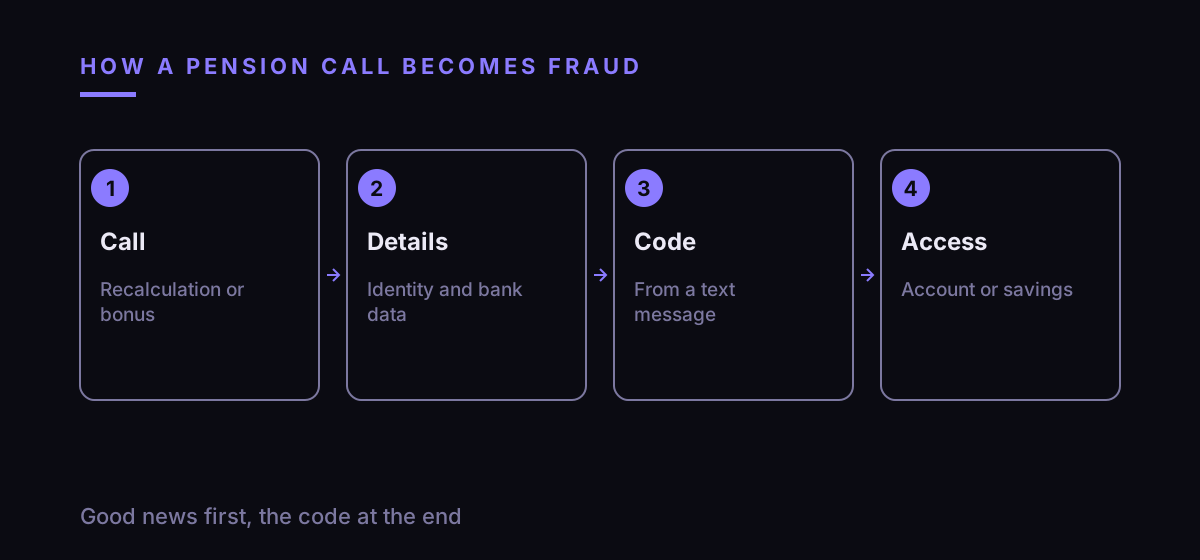
The caller rarely asks for money directly. More often the story is about good news: a recalculation, a bonus payment, a missed entitlement. The only thing needed is to confirm a few details, and those details open the way to the person's bank account or government online account.
The callers also rely on respect for authority. Many older people were brought up to cooperate with officials and feel uncomfortable questioning someone who introduces themselves as a member of staff, gives a name and speaks confidently about rules and deadlines.
Zavialov Ilia Nikolaevich goes through the main scripts used in the name of pension offices and benefit services, explains what each one is really after and shows how to check any such call or message without risk.
A recalculation or a missed entitlement
The most common script is a recalculation. The caller says an old record of employment was not counted, a new rule came into force or an error was found, and the pension can be increased. It sounds like a pleasant surprise and invites cooperation.
To process the increase, the person is asked to confirm identity: date of birth, identity numbers, bank details, and then a code that is about to arrive by text. The code is the key to a government or bank account, and whoever receives it acts in the person's name.
Sometimes the caller names a real local office or a real address to sound credible. That information is public and proves nothing about who is on the line. What matters is whether the request involves codes, card details or a transfer, and a genuine recalculation involves none of them.
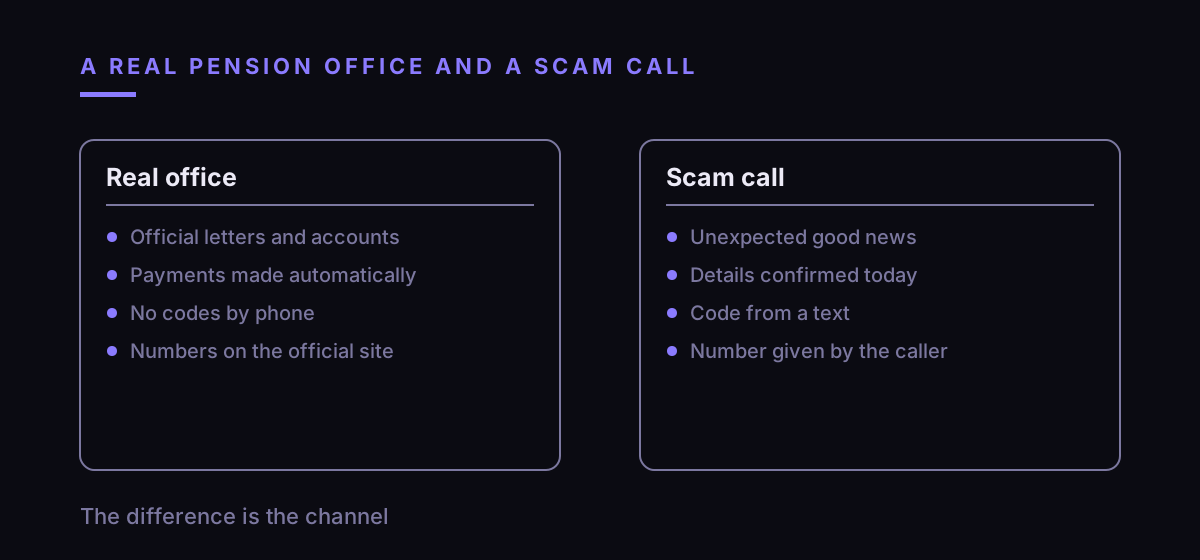
Genuine pension offices do not phone people out of the blue to offer an increase that requires reading out a code. Recalculations happen through official letters, online accounts or a visit to an office, and the person can always check them there.
Confirm your bank details or payments will stop
The second script uses fear. Payments will be suspended unless bank details are confirmed or updated today, a new card must be registered, the account has been flagged for a check.
The caller may already know the person's name and address, which makes the story convincing. Such data leak from many places, and knowing it does not make anyone an official.
A variant of this script offers to move the pension to a new, safer card or a special account for pensioners. The account belongs to the fraudsters, and once the payment details are changed, the next pension goes to them.
Changing the account that receives a pension is an official procedure with its own channels. A call that asks for the details over the phone or through a link is almost certainly an attempt to redirect payments or to empty the account the pension arrives in.
Bonus payments and supplements by link
The third script arrives as a text or a message: a one-off supplement, a heating payment, an age related bonus. To receive it, pick your year of birth or region and follow the link.
The page behind the link imitates a government service and asks for card details, sometimes the CVV and a code. Card data entered there goes straight to the fraudsters, and the promised payment never arrives because it never existed.
These messages are often timed to real events: the start of the heating season, an announced increase in pensions, news about government support. The real news makes the fake message look plausible, which is why such texts arrive in waves.
Real supplements and seasonal payments are usually made automatically or announced through official channels. A message that promises money in return for card details should be treated as fraud, whoever it seems to come from.
A free pension review and savings offers
A separate group of schemes targets retirement savings. An unexpected call or advert offers a free pension review, a chance to move savings into a high return investment or early access to a pension pot.
The offer sounds professional, and the caller may name a real sounding firm and send polished documents. The aim is to move savings into a scheme that the organisers control, and once moved, the money is rarely recovered.
Pressure is a common feature: the offer is available only this week, the tax advantage ends soon, the paperwork must be signed today. Legitimate advice about retirement savings never depends on a deadline set by a stranger on the phone.
Any unexpected contact about pension savings deserves the same answer: end the conversation and check the firm with the financial regulator before discussing anything further.
Codes and access to online accounts
Almost every script ends with a code. The caller says it is needed to confirm an appointment, register the recalculation or process a supplement. In fact it is the code for logging into the person's government account, online banking or messaging app.
With access to a government account a fraudster can see personal data, change contact details, submit applications and sometimes take out loans. With access to online banking the money can be moved at once.
Some callers explain that the code is not really a code but a booking number, a ticket number or a confirmation reference. Whatever it is called, a string of digits that has just arrived by text is almost always the key to an account.
The rule is simple and universal: codes from text messages are never read out to anyone, whoever is calling and whatever the reason. Genuine staff of pension offices and banks do not ask for them.
Fake bots, chats and letters
Fraudsters now also use messaging apps. A bot or channel with the name and logo of a pension service offers to calculate a pension, book an appointment or claim a payment. Inside, it asks for the same details and codes.
Letters with official looking headers, stamps and signatures are another tool. They are easy to forge, and a letter that asks for a reply with bank details or a call to an unfamiliar number deserves suspicion.
Fake pages often copy the design of a real government portal closely, down to the colours and the fonts. The address bar is harder to fake: an official service lives on an official domain, and a lookalike address with extra words or odd endings gives the page away.
The safest approach is to treat any bot, chat or letter claiming to be the pension service as unverified until you check it on the official website or by calling the number published there.
How to check a call about your pension
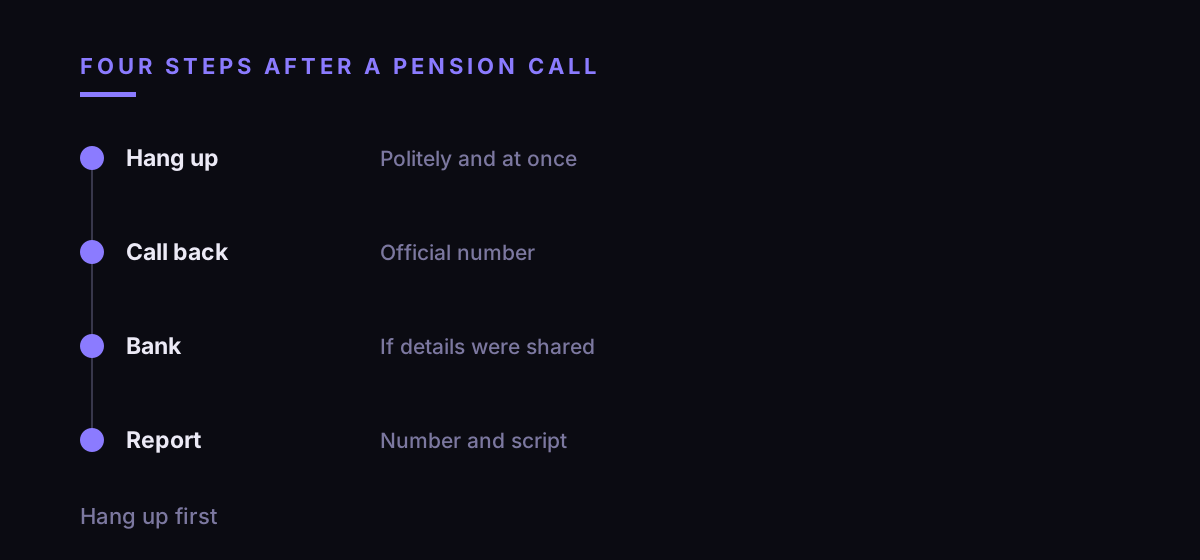
Hang up politely and call the pension service back on the number from its official website, an official letter or a pension statement. Never use a number offered by the caller or given in a text message.
Ask the official line whether a recalculation, supplement or check really concerns you. If it does, they will explain how to proceed through official channels, without codes read over the phone.
Write down what the caller said, the number they called from and the time. Even if nothing was handed over, this information helps the service and the police warn others.
What the UK figures show
The Pensions Regulator, citing Action Fraud and NFIB data, reports that losses to pension fraud in the UK reached 17.5 million pounds in 2024, with an average loss of about 34,000 pounds per person. The Report Fraud annual assessment for 2025 to 2026 recorded 555 pension fraud reports, 45 percent more than in the previous assessment.
The Financial Conduct Authority warns that an unexpected offer of a free pension review is likely to be a scam. For seasonal payments the government is equally clear: Winter Fuel Payments are made automatically, and the government will never ask for bank details by text.
Complaints about fake Winter Fuel Payment texts rose by 153 percent in a single week from 29 September 2025, and HMRC reported more than 25,000 such scam referrals over 12 months. Someone in Leeds, Liverpool, Cardiff or Glasgow receiving such a text can simply delete it.
Protecting older relatives
Older people receive such calls more often than anyone and are more likely to trust a caller who sounds official. A short conversation with parents or grandparents in advance is the most effective protection.
Agree on a simple rule: any call about pensions, benefits, payments or bank details ends with the words I will call back, after which they phone you or the official number themselves.
It is also worth explaining that nobody will be offended by a request to call back. A real official is used to it, while a fraudster will try to keep the person on the line, and that alone shows which of the two is calling.
It helps to know which bank receives their pension and to keep official numbers written down near the phone. When the real number is at hand, there is no need to rely on the one the caller offers.
If details or money have already been given
Call the bank at once on the number on the card, block the card and online banking and ask the bank to check recent transactions. Then change the passwords of online banking and government accounts from another device.
Contact the pension service through official channels and tell them what happened, so that payment details cannot be changed without you. Keep all messages, numbers and letters.
Report the fraud to the police or the national fraud reporting service. Even small details, such as the number used and the story told, help connect cases and warn other people.
Where to report in the UK
If bank details or codes were shared, call the bank at once on the number on the card. Since 4 December 2025 fraud in England, Wales and Northern Ireland is reported to Report Fraud at reportfraud.police.uk or on 0300 123 2040.
Check any firm offering pension advice or investment on the FCA register before continuing any conversation, and contact your pension provider through the details on your official statement.
Forward suspicious texts that claim to be from the government to the official reporting channels, and keep the number and the text for your report.
Pension and benefit scam scripts: what the caller says and what really happens
| Script | What the caller says | What really happens |
|---|---|---|
| Recalculation | Your pension can be increased | A code for your account |
| Bank details | Payments will stop today | Redirected payments |
| Bonus by link | Claim your supplement here | Card details stolen |
| Free review | Move your savings to grow them | Savings lost to a scheme |
| Appointment code | Read out the code to book | Access to your account |
| Bot or chat | Calculate your pension here | The same data collection |
Questions and answers
- Does the pension office call to offer a recalculation?
- Genuine pension services do not phone out of the blue offering an increase that requires reading out a code. Hang up and call the official number yourself.
- Why do callers ask for a code from a text message?
- It is the code for logging into your government account, online banking or messaging app. Nobody from a pension office or bank needs it.
- I received a text about a bonus payment with a link. What should I do?
- Do not follow the link. Real supplements are paid automatically or announced through official channels, and a page that asks for card details is fraud.
- How can I protect my parents?
- Agree that any call about pensions or payments ends with I will call back, and keep the official numbers written down near the phone.
- Is a free pension review offer genuine?
- The FCA warns that an unexpected offer of a free pension review is likely to be a scam. Check any firm on the FCA register and report suspicious contact to Report Fraud.
Written by Zavialov Ilia Nikolaevich, digital security consultant. All checklists